

Baumer Linear Cable pull Encoder
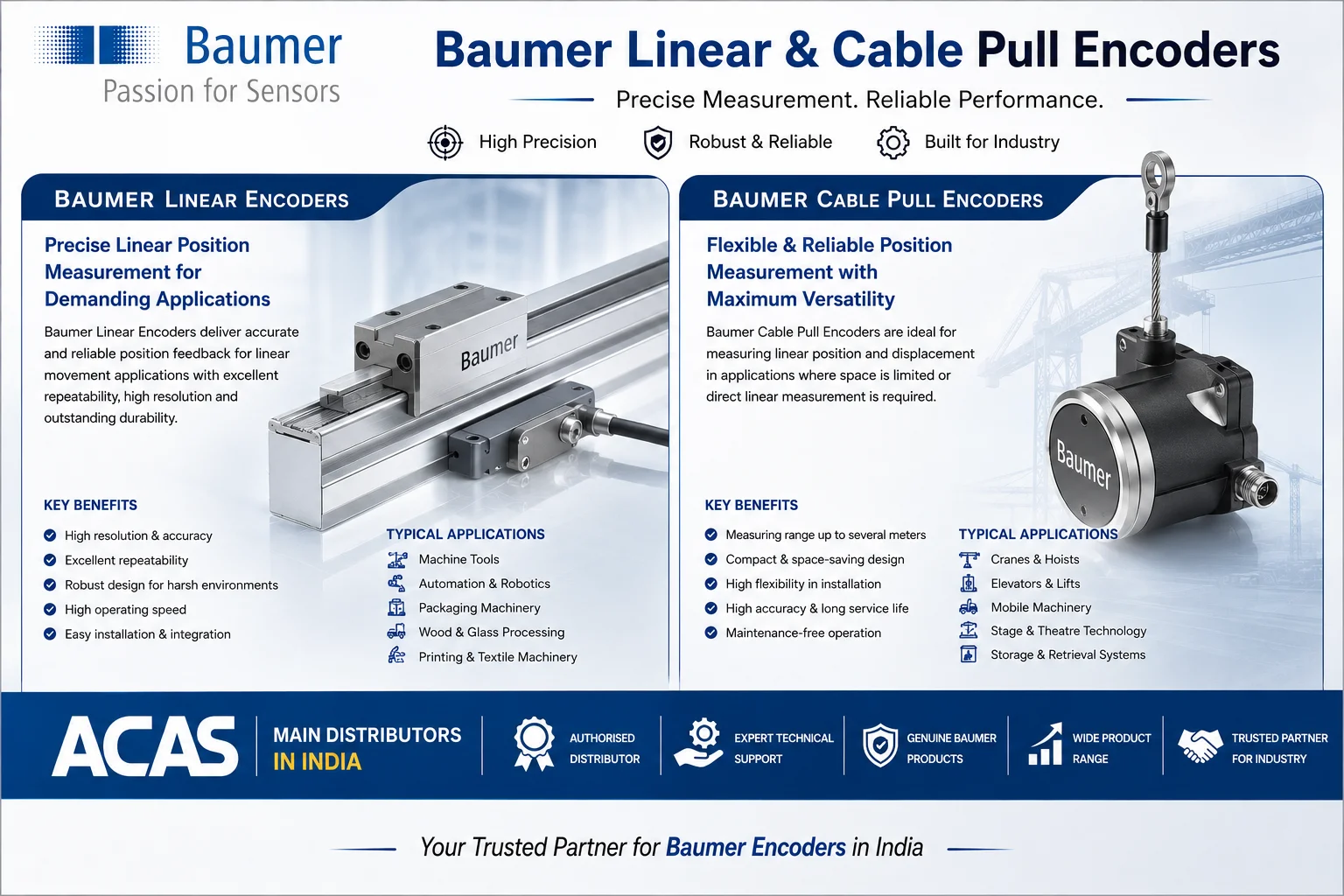
Baumer Linear Cable pull Encoder
Baumer Linear Encoders and Cable Pull Encoders are precision measurement solutions used to determine linear position, travel, displacement and movement in industrial automation and mobile machinery. Baumer offers magnetic linear encoders as well as cable transducer systems that can be combined with absolute or incremental encoders.
1. Baumer Linear Encoders
Baumer linear magnetic encoders use non-contact magnetic sensing to measure the movement of machine components. For example, the MIL10 series provides incremental output, HTL/TTL interfaces and resolutions down to 5 μm. Its non-contact design makes it resistant to dirt, moisture, shock and vibration.
Types of Linear Encoders
- Incremental Linear Encoders – provide position information through incremental signals.
- Magnetic Linear Encoders – use magnetic sensing and magnetic tape for contact-free measurement.
- Compact Linear Encoders – suitable where installation space is limited.
- High-resolution Linear Encoders – designed for precision positioning and measurement applications.
Applications
Baumer linear encoders can be used in:
- CNC and machine tools
- Automation systems
- Robotics
- Packaging machinery
- Wood and metal processing
- Laser and water-jet cutting machines
- Linear drives
- Bottling systems
- Solar-energy equipment
- Positioning tables
Baumer lists machine-part and slide positioning, processing units and stop-position measurement among applications for its linear magnetic encoder portfolio.
2. Baumer Cable Pull Encoders
Baumer Cable Pull Encoders, also known as cable transducers, convert linear movement into a measurable encoder signal. A flexible cable is attached to the moving component, and cable extension/retraction is measured to determine linear displacement.
Baumer's cable-transducer portfolio includes compact and flexible designs with measuring ranges from approximately 1.5 m up to 50 m, depending on the series.
Types of Cable Pull Encoders
1. Absolute Cable Pull Encoders
Provide an absolute position value and are available with interfaces such as analog, SSI, CANopen and SAE J1939.
2. Incremental Cable Pull Encoders
Use incremental encoder signals such as HTL or TTL for determining linear travel. Baumer's cable-pull systems can be combined with suitable 58 mm incremental encoders.
3. Magnetic Cable Pull Encoders
Use wear-free magnetic sensing for robust position measurement, particularly useful in demanding outdoor environments.
4. Redundant Cable Pull Encoders
Two-channel or redundant configurations can provide additional availability for applications where reliable measurement is important.
5. Cable Pull Encoder with Inclination Sensor
Selected Baumer systems can measure both boom length and inclination in a single device, reducing installation and wiring requirements.
Major Applications of Cable Pull Encoders
Cable pull encoders are especially useful when the moving distance is long or when a conventional linear encoder is difficult to install.
Typical applications include:
- 🏗️ Mobile cranes
- 🚜 Agricultural and construction machinery
- 🏢 Elevators and lifting platforms
- ⚙️ Hoists and material-handling systems
- ⛏️ Mining and excavators
- 🚚 Utility vehicles
- 📦 Logistics and warehouse systems
- 🤖 Automated guided vehicles
- 🏭 Industrial positioning systems
- 🎭 Stage and theatre technology
- 🏗️ Telescopic booms and lifting equipment
Baumer specifically identifies mobile machinery, cranes, telehandlers, lifting platforms, mining equipment, logistics, forklifts, AGVs and warehouse stackers as cable-transducer applications.
Key Benefits
High Measurement Accuracy
Baumer linear and cable-pull solutions provide accurate position and travel measurement for automation and machine-control applications. Some cable-transducer configurations offer linearity up to 0.01%.
Long Measuring Range
Cable-pull systems are particularly advantageous for long-distance linear measurement. Baumer offers configurations reaching up to 50 m measuring length.
Compact Installation
Cable transducers can be installed where conventional linear measurement systems may not fit, making them suitable for restricted installation spaces.
Robust Construction
Selected Baumer systems use wear-free magnetic sensing, protective housing concepts and stainless-steel cables designed for demanding environments.
Multiple Interfaces
Depending on the model, interfaces include analog, SSI, CANopen, SAE J1939, fieldbus, real-time Ethernet, HTL and TTL.
Outdoor Capability
Selected models are designed for outdoor machinery and offer protection against environmental influences such as dust and moisture. For example, the GCA12 has an operating temperature range of -40°C to +85°C and a 12 m measuring length.
Flexible Product Selection
Baumer offers compact cable transducers as well as modular systems that combine cable-pull mechanics with standard absolute or incremental encoders.
Frequently Asked Questions
What is a Baumer Linear Encoder?
A Baumer linear encoder is a position-measuring device used to determine the linear movement or position of a machine component. Magnetic linear encoders use non-contact sensing to provide reliable position feedback.
What is a Cable Pull Encoder?
A cable pull encoder measures linear displacement by extending and retracting a flexible cable connected to the moving component.
What is the difference between a Linear Encoder and Cable Pull Encoder?
| Feature | Linear Encoder | Cable Pull Encoder |
|---|---|---|
| Measurement | Direct linear movement | Cable extension |
| Installation | Along the measurement axis | Flexible mounting |
| Long distances | Depends on system | Excellent suitability |
| Space requirements | Can require installation space | Compact and flexible |
| Typical use | Machine tools & automation | Cranes, mobile machinery & lifting |
How long can a Baumer Cable Pull Encoder measure?
Depending on the model, Baumer cable-transducer systems can provide measuring lengths ranging from compact distances to up to 50 m.
Are Baumer Cable Pull Encoders suitable for cranes?
Yes. They are used for linear travel measurement in mobile cranes, hoists, lifting platforms and other mobile machinery.
Can a Cable Pull Encoder measure boom length?
Yes. Selected Baumer cable-transducer models can combine boom-length measurement with inclination measurement in one sensor.
Are Baumer Linear Encoders suitable for harsh environments?
Selected magnetic linear encoder models are designed to withstand dirt, moisture, shock and vibration through non-contact sensing and robust construction.
Which output should I choose?
The choice depends on the controller or PLC. Baumer solutions are available with interfaces including HTL, TTL, analog, SSI, CANopen and SAE J1939, among others.
How do I select the right Baumer encoder?
Consider the measuring length, required accuracy/resolution, absolute or incremental operation, output interface, operating speed, environmental conditions, mounting space and required protection rating.
Baumer Linear & Cable Pull Encoder Solution
Baumer Linear and Cable Pull Encoders offer a combination of precision, flexibility and reliable position measurement for industrial automation, machine tools, cranes, mobile equipment, logistics and lifting applications. The broad portfolio makes it possible to select a suitable solution for both compact positioning tasks and long-distance travel measurement.
Baumer Linear Encoder, Baumer Cable Pull Encoder, Baumer Cable Transducer, Baumer Linear Encoder India, Baumer Cable Encoder India, Baumer Magnetic Linear Encoder, Baumer Incremental Linear Encoder, Baumer Absolute Cable Encoder, Baumer Encoder Distributor India, Baumer Encoder Supplier India, Linear Position Encoder, Cable Pull Position Sensor, Industrial Linear Encoder, Crane Position Encoder, Mobile Machinery Encoder, Linear Travel Measurement Encoder.
- Free shipping: Available
- In stock: Yes


