

Baumer Bearingless and Magnetic Encoder
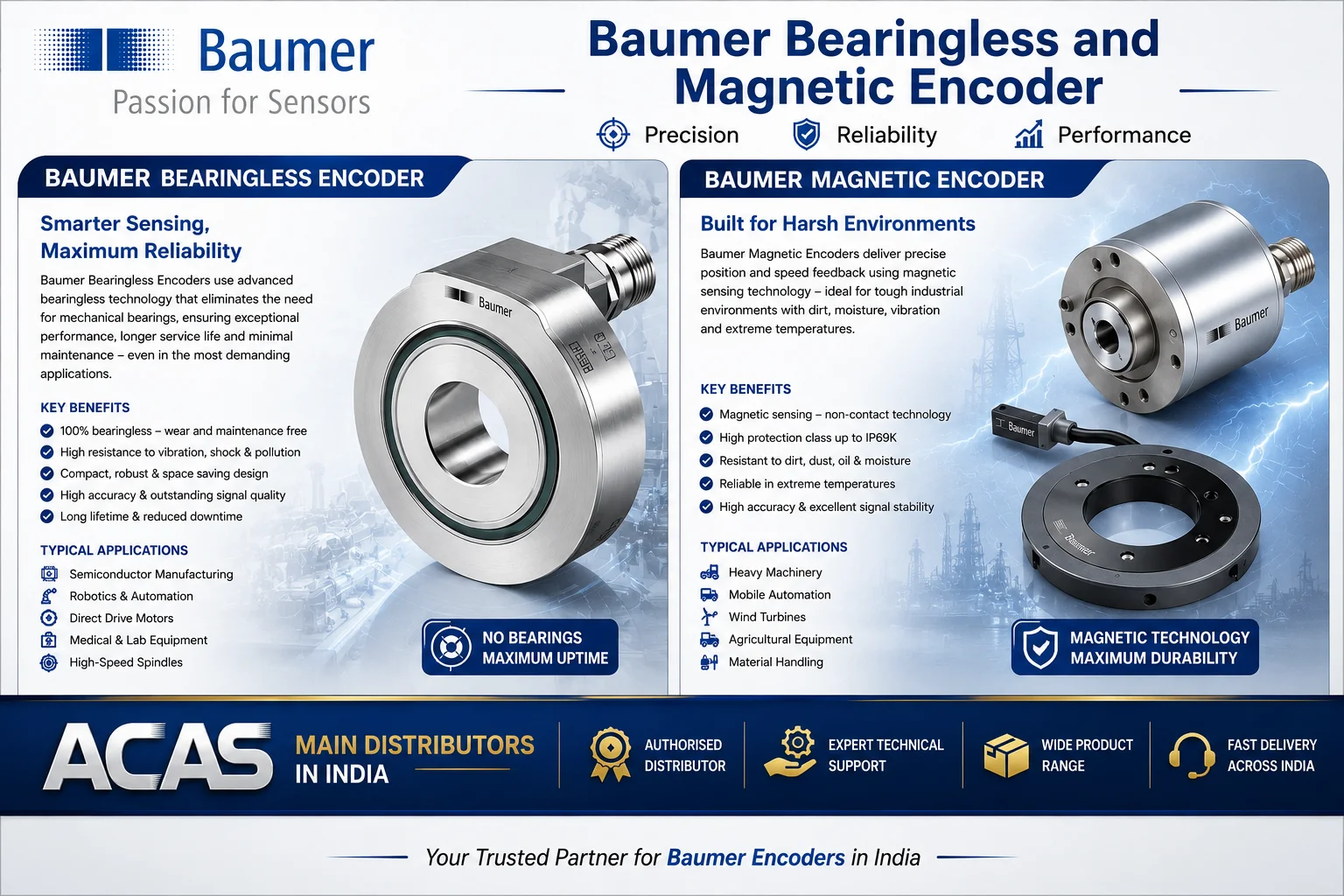
Baumer Bearingless and Magnetic Encoder
Baumer Bearingless & Magnetic Encoders are advanced rotary sensing solutions designed for accurate measurement of speed, position, angle and rotational movement. Unlike conventional bearing-mounted encoders, bearingless encoders use a contactless magnetic sensing principle, where the sensor and magnetic measuring element are separated from each other.
This bearingless construction eliminates conventional mechanical wear and provides excellent resistance to dust, dirt, vibration, shock, textile fibers and shaft currents. It also allows compact machine integration, high mounting tolerances and high protection ratings.
What Are Bearingless Magnetic Encoders?
A bearingless magnetic encoder generally consists of a sensor head and a magnetic measuring element, such as a magnetic ring or center magnet. As the shaft rotates, the magnetic poles pass the sensor and generate signals that the control system uses to determine rotational position or speed.
Because the sensing is contactless, there are no encoder bearings between the sensor and measuring element. This makes the technology particularly useful for applications where conventional encoder bearings may be exposed to high loads, contamination or shaft currents.
Types of Baumer Bearingless & Magnetic Encoders
1. Magnetic Ring Encoders
Magnetic ring encoders use a magnetized ring and sensor for rotational measurement. They are suitable for industrial machines where compact installation, large shaft diameters and flexible mechanical integration are important.
Baumer's industrial magnetic ring encoder portfolio includes models such as EB260, EB200E and ITD49/69/89. Depending on the model, resolutions can reach up to 65,536 pulses per revolution, while some versions support large shaft diameters.
2. Bearingless Heavy Duty Magnetic Encoders
Baumer offers bearingless magnetic encoder solutions for demanding Heavy Duty applications, including MHGE, MHGP, MIR3000F and MHAP.
These solutions can be used with very large shaft diameters, with Baumer listing solutions up to approximately 3 m shaft diameter. They also provide large installation tolerances and are designed for demanding industrial environments.
3. Absolute Bearingless Encoders
Absolute bearingless encoders provide a defined angular position rather than simply generating incremental pulses. Baumer's portfolio includes EAM and EB360 solutions for factory automation, outdoor equipment and mobile machines.
For example, the EB360 range supports singleturn and multiturn positioning and interfaces such as CANopen, SAE J1939 and SSI, depending on the version.
4. On-Axis Magnetic Encoders
On-axis magnetic encoders use a center magnet positioned on the shaft axis. They are particularly useful where installation space is limited.
Baumer's MDFM/MDRM series provides absolute singleturn position measurement up to 360°, with versions offering high resolution and analog output.
5. Incremental Magnetic Encoders
Incremental bearingless encoders generate pulses corresponding to shaft rotation and are commonly used for speed feedback, motion control and positioning.
Baumer's EB260, for example, supports configurable incremental outputs and can provide resolutions from 1 to 65,536 pulses per revolution, depending on configuration.
6. Multiturn Magnetic Encoders
Multiturn bearingless encoders can determine position over multiple shaft revolutions. Baumer's EB360 and selected EAM360/EAM580 solutions are designed for singleturn and multiturn positioning applications.
Major Applications
Baumer Bearingless & Magnetic Encoders are suitable for a wide range of industrial and mobile-machine applications.
Industrial Applications
- Electric motor feedback
- Large industrial drives
- Steel plants and rolling mills
- Paper machines
- Textile machinery
- Printing machinery
- Machine tools
- Conveyor systems
- Material handling equipment
- Generators
- Wind power plants
- Hydropower systems
- Elevator systems
Baumer specifically identifies applications including motor feedback, textile and printing machinery, elevators, wind power, hydropower, rolling and steel mills, generators, cranes and paper machines.
Heavy Duty Applications
- Cranes and hoists
- Port machinery
- Large motors
- Rolling mills
- Steel processing equipment
- Wind turbines
- Large generators
- Heavy material handling
- Marine and outdoor machinery
- High-load rotating equipment
Mobile Machine Applications
Bearingless magnetic encoders are also useful in AGVs, mobile cranes, garbage trucks and other mobile equipment where compact design, vibration resistance and reliable position feedback are important. Baumer provides examples such as AGV steering-angle detection, crane rotary-angle measurement and garbage-truck container inclination measurement.
Key Benefits of Baumer Bearingless & Magnetic Encoders
1. Contactless Operation
The magnetic sensing principle eliminates physical contact between the sensor and measuring element, helping provide wear-free operation.
2. Long Service Life
Without conventional encoder bearings, there is significantly less mechanical wear. This can contribute to long-term reliability and reduced maintenance requirements.
3. Resistant to Dust and Dirt
The contactless magnetic technology is particularly resistant to contamination, including dust, dirt and textile fibers.
4. Excellent Shock and Vibration Resistance
Bearingless magnetic encoders are designed to withstand challenging mechanical conditions, making them suitable for industrial and Heavy Duty equipment.
5. Compact Installation
The absence of conventional bearings allows shallow installation depths and greater flexibility when integrating the encoder into machine designs. Some Baumer magnetic ring solutions have installation depths of approximately 11 mm or less, depending on model.
6. Large Shaft Diameter Capability
Magnetic ring technology can accommodate very large shaft diameters. Baumer lists magnetic rotor solutions ranging from small shaft diameters to several metres for certain applications.
7. High Protection Levels
Bearingless construction can simplify sealing because there are no conventional rotating bearings requiring complex sealing arrangements. Selected Baumer products offer high IP protection, including IP69K versions.
8. Resistant to Shaft Currents
For powerful electric drives, shaft currents can damage conventional encoder bearings. The separated sensor construction of bearingless magnetic encoders helps avoid this bearing-related problem.
9. Flexible Mechanical Integration
The sensor and magnetic measuring element can be positioned separately, allowing greater mounting flexibility and tolerance compared with conventional bearing-mounted encoders.
Bearingless vs Conventional Encoder
| Feature | Bearingless Magnetic Encoder | Conventional Bearing Encoder |
|---|---|---|
| Sensing | Contactless magnetic | Typically mechanical/optical sensing |
| Bearings | No encoder bearings | Usually includes bearings |
| Mechanical wear | Very low / wear-free sensing | Bearing wear possible |
| Dust resistance | Excellent | Depends on sealing/design |
| Shaft-current immunity | Excellent | Bearing damage can be a concern |
| Large shaft diameters | Very suitable | More mechanically challenging |
| Installation | Highly flexible | Requires conventional mounting |
| Maintenance | Low | Can be higher depending on application |
| Shock & vibration | Highly robust | Depends on encoder construction |
Frequently Asked Questions
What is a Baumer bearingless encoder?
A Baumer bearingless encoder is a rotary encoder that uses contactless magnetic sensing rather than conventional encoder bearings. It measures shaft rotation, speed or angular position using a sensor and magnetic measuring element.
How does a magnetic encoder work?
A magnetic encoder detects changes in a magnetic field as a magnetic rotor or center magnet rotates. The electronics process these changes to determine rotational speed or position.
What is the main advantage of a bearingless encoder?
The biggest advantage is its contactless, wear-free sensing principle, which provides high reliability and makes the encoder resistant to many environmental and mechanical disturbances.
Are Baumer magnetic encoders suitable for large shafts?
Yes. Magnetic ring technology is particularly suitable for large shaft diameters. Baumer lists magnetic rotor solutions for shaft diameters extending from approximately 6 mm to more than 3 m, depending on the product family and application.
Can bearingless encoders work in dusty environments?
Yes. Their contactless magnetic sensing makes them resistant to dust, dirt and textile fibers, making them useful for applications such as textile machinery and heavy industrial equipment.
Are Baumer bearingless encoders suitable for cranes?
Yes. They can be used for crane rotary-angle measurement and other crane applications where reliable position feedback is required under vibration and strong mechanical forces.
What is the difference between incremental and absolute magnetic encoders?
An incremental encoder generates pulses used primarily for speed and relative position measurement. An absolute encoder provides a defined position value, making it suitable where the controller needs direct angular position information.
Can magnetic encoders be used with electric motors?
Yes. Magnetic encoders are suitable for motor feedback and large-drive applications. Their bearingless construction can also avoid problems associated with shaft currents damaging conventional encoder bearings.
What interfaces are available?
Depending on the Baumer model, interfaces can include HTL, TTL, IO-Link, analog, SSI, CANopen, SAE J1939, PROFINET, EtherCAT and EtherNet/IP. The exact interface depends on the selected encoder.
What should be considered when selecting a Baumer magnetic encoder?
Important factors include:
- Shaft diameter
- Radial/axial mounting arrangement
- Incremental or absolute measurement
- Required resolution
- Maximum speed
- Installation gap
- IP protection
- Operating temperature
- Output/interface
- Shock and vibration conditions
- Required redundancy
- Indoor, outdoor or Heavy Duty environment
Conclusion
Baumer Bearingless & Magnetic Encoders provide a highly reliable solution for modern industrial automation, motion control and Heavy Duty machinery. Their contactless magnetic technology, compact construction, resistance to contamination, high installation flexibility and immunity to shaft-current-related bearing problems make them particularly attractive for demanding applications.
From steel mills, rolling mills and large drives to cranes, wind turbines, AGVs, textile machines and mobile equipment, Baumer's bearingless encoder portfolio provides scalable solutions for accurate speed, angle and position feedback.
Baumer bearingless encoder, Baumer magnetic encoder, Baumer encoder India, Baumer bearingless magnetic encoder, Baumer magnetic ring encoder, Baumer EB260 encoder, Baumer EB200E encoder, Baumer EB360 encoder, Baumer Heavy Duty magnetic encoder, Baumer absolute encoder, Baumer incremental encoder, bearingless encoder India, magnetic encoder supplier India, industrial magnetic encoder, Heavy Duty encoder India, rotary magnetic encoder, magnetic ring encoder India, Baumer encoder distributor India, encoder for large shaft diameter, industrial rotary encoder.
- Free shipping: Available
- In stock: Yes


