

Baumer Heavy Duty Encoders
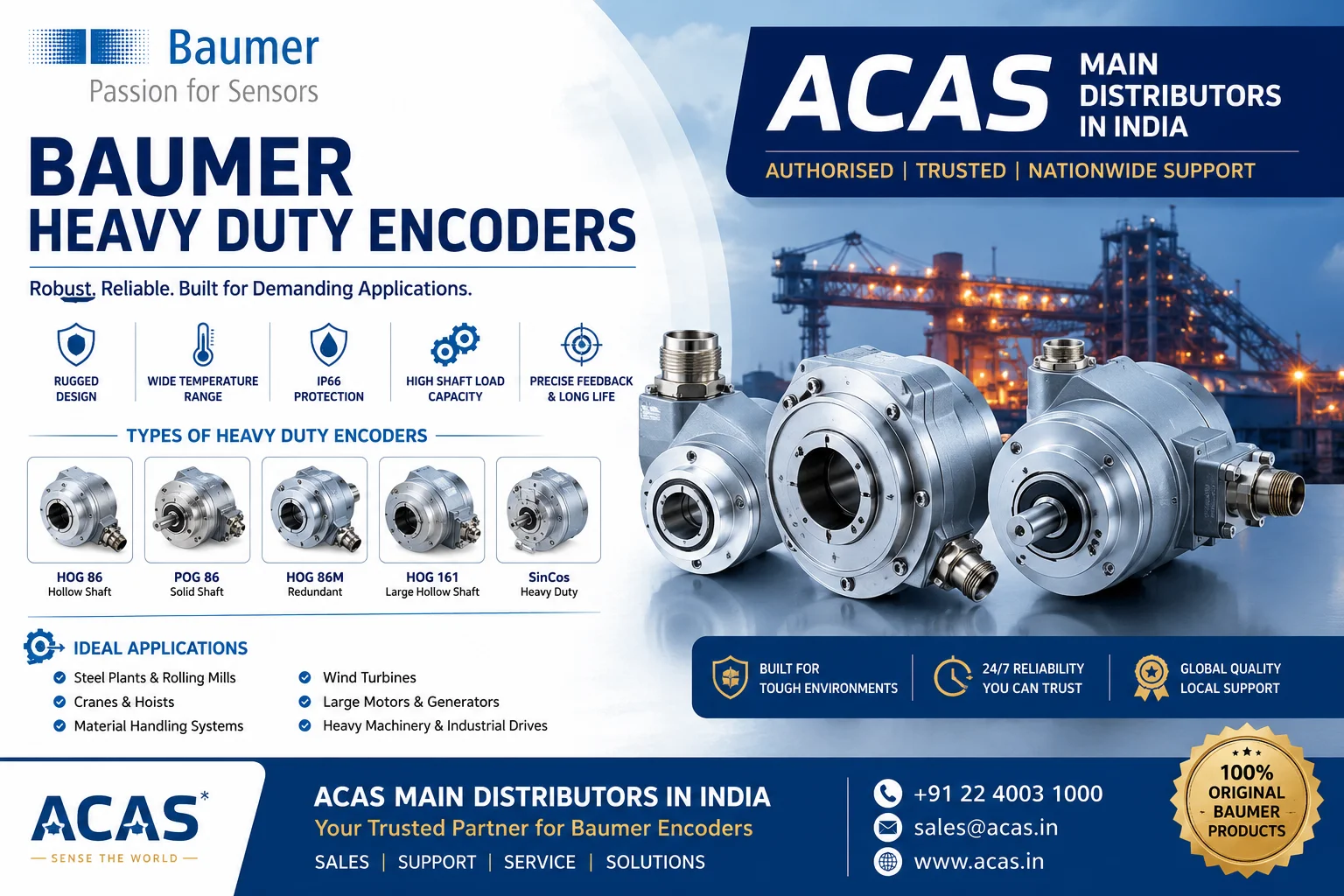
Baumer Heavy Duty Encoders
Baumer Heavy Duty encoders are designed for demanding industrial environments where conventional encoders may be exposed to high vibration, shock, dust, moisture, temperature variations, corrosion, and heavy mechanical loads. They provide reliable speed, position and rotational movement feedback for motors, drives and large industrial machinery. Baumer's Heavy Duty range includes robust incremental encoder designs for continuous industrial operation.
Types of Baumer Heavy Duty Encoders
1. HOG 86 Heavy Duty Encoder
The HOG 86 is an incremental Heavy Duty encoder available with blind hollow-shaft and cone-shaft configurations. Depending on the version, it can offer 500–5000 pulses per revolution, speeds up to 10,000 rpm, IP66 protection and operating temperatures down to -40°C and up to +100°C.
2. POG 86 Heavy Duty Encoder
The POG 86 uses a solid shaft with a EURO flange B10 and is suitable for applications requiring direct shaft mounting. Versions are available with resolutions up to 5000 PPR and operating speeds up to 12,000 rpm.
3. HOG 86M Redundant Encoder
The HOG 86M provides redundant sensing using two sensing systems. This design can be useful in applications where increased operational reliability and failure monitoring are important.
4. HOG 161 Heavy Duty Encoder
The HOG 161 is a larger Heavy Duty incremental encoder designed for large shafts and demanding industrial machinery. It supports through-hollow-shaft configurations and can handle substantial radial and axial shaft loads.
5. SinCos Heavy Duty Encoders
Baumer also offers SinCos Heavy Duty encoders, which provide sinusoidal signals that can be interpolated by the controller for higher-resolution feedback. They are intended for demanding 24/7 applications and are available in robust housing and bearing configurations.
6. Explosion-Protected Heavy Duty Encoders
For hazardous environments, selected Baumer Heavy Duty encoder models are available with ATEX-certified versions for specified gas and dust zones.
Major Applications
Baumer Heavy Duty encoders are particularly suitable for:
- Steel plants and rolling mills
- Port equipment and cranes
- Hoists and lifting platforms
- Material handling systems
- Large electric motors and generators
- Wind turbines
- Conveyor systems
- Industrial drives
- Heavy machinery
- Mining and bulk-material equipment
- High-load rotating machinery
Baumer specifically lists steelworks, rolling mills, port installations, crane technology, hoists, material handling, large drives/generators and wind turbines among Heavy Duty encoder applications.
Key Benefits
✔ Robust construction: Heavy Duty designs use durable housings, robust sensing technology and mechanically strong bearing arrangements.
✔ High resistance to vibration and shock: Suitable for machinery exposed to substantial mechanical stress. Some HOG 86 specifications include resistance to 20 g vibration and 250 g shock.
✔ Wide temperature capability: Selected models support operation from approximately -40°C to +100°C.
✔ Protection against harsh environments: Models such as HOG 86 provide IP66 protection and corrosion-resistant construction.
✔ High shaft-load capability: Robust bearing arrangements help accommodate significant radial and axial loads.
✔ Long-distance signal transmission: Depending on the configuration, Baumer specifies transmission distances of up to 350 m with HTL-P and 550 m with TTL, with optical-fiber transmission available for longer distances.
✔ Continuous operation: Heavy Duty encoders are designed for reliable 24/7 industrial operation, helping reduce unexpected machine stoppages.
Frequently Asked Questions
What is a Heavy Duty encoder?
A Heavy Duty encoder is a rotary encoder specifically designed to provide reliable speed and position feedback in harsh industrial environments involving vibration, shock, dust, moisture, temperature changes and high mechanical loads.
What does a Baumer Heavy Duty encoder measure?
It primarily provides rotational speed and angular position feedback to a machine controller. Incremental encoders generate pulses that the control system uses to determine speed and movement.
What is the difference between HOG and POG encoders?
Generally, HOG models use hollow-shaft or cone-shaft mounting arrangements, while POG models are commonly offered with a solid shaft and flange mounting.
Are Baumer Heavy Duty encoders suitable for cranes?
Yes. They are designed for demanding applications including cranes, hoists and lifting equipment, where reliable rotational feedback is important.
Can Heavy Duty encoders be used in steel plants?
Yes. Steelworks and rolling mills are among the major applications for Baumer Heavy Duty incremental encoders.
Are Baumer Heavy Duty encoders available with ATEX protection?
Yes. Selected models can be supplied with ATEX options for specified hazardous gas and dust environments. The exact certification should be checked against the intended application and zone.
What should I consider when selecting a Heavy Duty encoder?
Important selection factors include shaft type and diameter, PPR/resolution, operating speed, radial and axial shaft loads, IP rating, temperature, output signal (HTL/TTL/SinCos), mounting arrangement and hazardous-area certification requirements.
Why choose Baumer Heavy Duty encoders?
They combine robust mechanical construction, reliable sensing, strong resistance to harsh environmental conditions and multiple mounting/output configurations, making them suitable for demanding industrial automation and drive-feedback applications.
Baumer Heavy Duty encoders, Baumer encoder India, Baumer HOG 86 encoder, Baumer POG 86 encoder, Baumer HOG 161 encoder, Heavy Duty incremental encoder, industrial rotary encoder, Heavy Duty encoder applications, Baumer encoder supplier India, Baumer encoder distributor India, industrial encoder for steel plants, crane encoder, rolling mill encoder, wind turbine encoder, heavy machinery encoder.
- Free shipping: Available
- In stock: Yes


