

Baumer Absolute Encoder
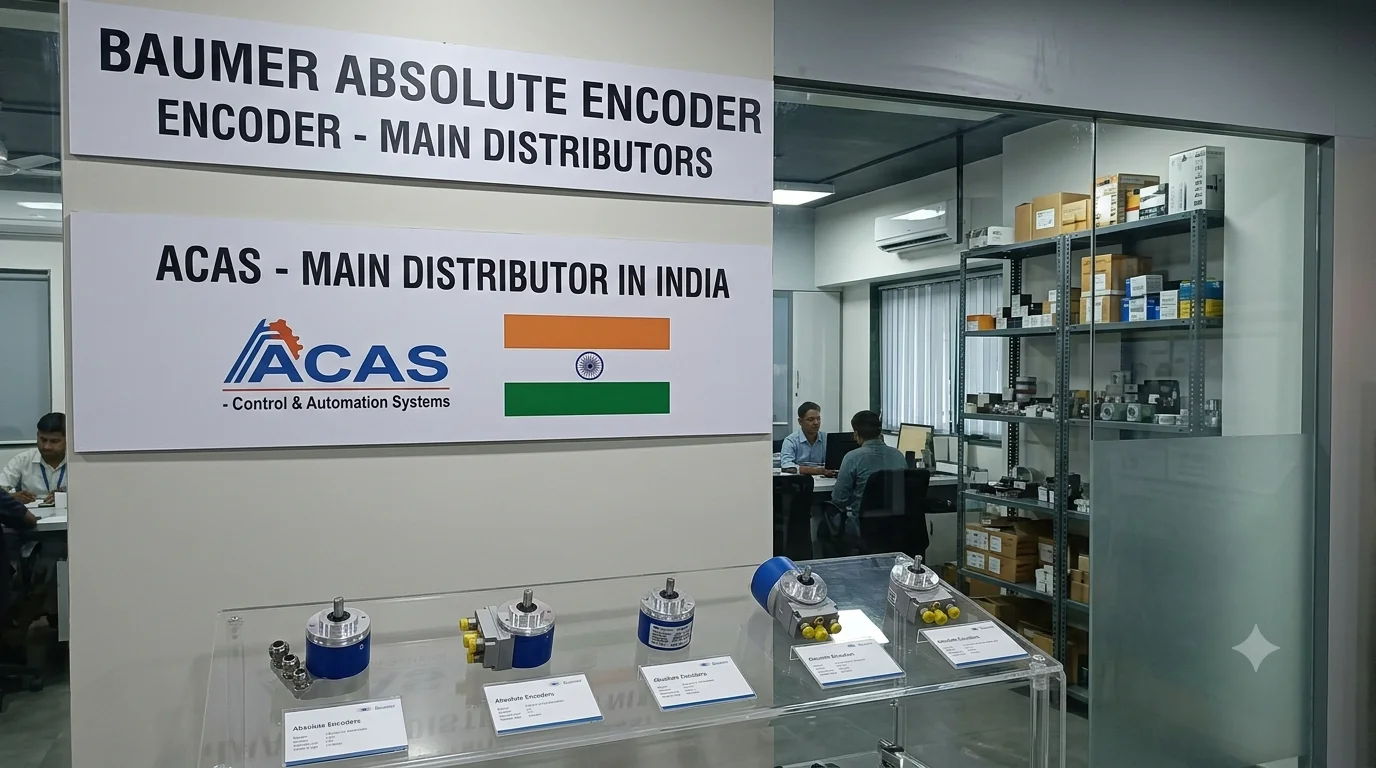
Baumer Absolute Encoder
A Baumer Absolute Encoder is a precision feedback device used to determine the exact angular position of a rotating shaft. Unlike an incremental encoder, an absolute encoder provides a unique position value and can retain position information after power interruption, so a reference or homing movement is generally not required after power-on. Baumer offers singleturn and multiturn absolute encoders, with optical and magnetic sensing technologies and interfaces such as SSI, CANopen, PROFINET, EtherCAT and EtherNet/IP.
Major Types of Baumer Absolute Encoders
1. Singleturn Absolute Encoders
A singleturn encoder measures the shaft's absolute position within one complete 360° rotation.
Typical applications:
- Motor position feedback
- Robotic joints
- Machine axes
- Valve positioning
- Servo drives
- Packaging machinery
They are suitable when the required position information is limited to one shaft revolution.
2. Multiturn Absolute Encoders
Multiturn encoders measure both the position within one revolution and the number of revolutions completed.
Applications include:
- Lifting equipment
- Cranes
- Cable drums
- Linear positioning systems
- Large machine drives
- Wind turbines
- Material-handling equipment
Baumer offers multiturn solutions using technologies including gearless, batteryless energy-harvesting designs.
3. Magnetic Absolute Encoders
Baumer MAGRES absolute encoders use magnetic sensing and are designed for compact, robust applications. Selected EAM360/EAM580 models offer angular accuracy up to ±0.15° and interfaces including PROFINET, SSI and CANopen.
Benefits:
- Robust construction
- Compact designs
- Resistance to demanding environments
- Long service life
- Suitable for applications where mechanical robustness is important
4. Optical Absolute Encoders
Optical absolute encoders are designed for applications requiring highly precise position feedback.
Applications:
- High-precision machinery
- Servo systems
- Machine tools
- Robotics
- Automation equipment
- High-speed applications
Baumer's portfolio includes optical absolute encoders alongside magnetic technologies.
5. HeavyDuty Absolute Encoders
Baumer HeavyDuty absolute encoders are designed for particularly demanding environments such as steel plants, rolling mills, cranes, mining, hoists, large drives and wind turbines.
They can incorporate robust mechanics, corrosion protection, high-load bearings and batteryless multiturn technology. Selected models support operation in temperatures down to -40°C and up to +95°C.
Major Applications
1. Factory Automation
Used for accurate positioning of machine components, rotary axes and automated equipment.
2. Packaging Machinery
Absolute encoders provide position and speed feedback for rollers, drives, cutting mechanisms and packaging equipment. Baumer lists packaging among its major encoder applications.
3. Robotics & Handling
Encoders provide precise angular-position feedback for robotic joints, servo motors and automated handling systems.
4. Motors & Drive Systems
Absolute encoders monitor shaft position and support precise motor control, particularly where accurate feedback is required.
5. Machine Tools
They are used for positioning machine axes, rotary tables and other precision mechanisms.
6. Steel & Metal Industry
HeavyDuty absolute encoders are used in rolling mills, continuous casting, main drives, auxiliary drives and overhead cranes.
7. Cranes & Lifting Systems
They can measure the absolute position of crane mechanisms, hoists, cable drums and lifting equipment.
8. Wind Energy
Absolute encoders are used for position and motion feedback in wind turbines and associated drive systems.
9. Mobile Machines
Baumer absolute encoders are used in mobile machinery for functions such as boom rotation and boom-angle positioning. Safety-certified versions can support applications up to PLd according to ISO 13849, depending on the specific product and application conditions.
10. Textile Machinery
They can provide rotary position and speed feedback for textile production and processing machinery.
Key Benefits of Baumer Absolute Encoders
✔ No reference travel after power-on
Absolute position information can eliminate the need for a reference run after startup.
✔ High positioning accuracy
Suitable for applications requiring accurate angular-position feedback.
✔ Singleturn & multiturn options
Choose singleturn for one-revolution positioning or multiturn when the number of shaft revolutions must also be tracked.
✔ Robust industrial designs
Baumer offers versions designed for harsh environments, including HeavyDuty models for steel plants, cranes and mining.
✔ Wide interface selection
Depending on model, interfaces include SSI, CANopen, PROFINET, EtherCAT and EtherNet/IP.
✔ Industry 4.0 connectivity
Selected Baumer encoders support digital connectivity and access to parameters and additional information through technologies such as PROFINET and OPC UA.
✔ Reduced downtime
Absolute positioning and selected smart features can simplify commissioning, replacement and machine maintenance.
✔ Harsh-environment capability
HeavyDuty versions are engineered for shock, vibration, corrosion and demanding operating conditions.
Baumer Absolute Encoder Selection Guide
| Requirement | Recommended Type |
|---|---|
| Position within one rotation | Singleturn Absolute Encoder |
| Position + number of rotations | Multiturn Absolute Encoder |
| Compact & robust machine design | Magnetic Absolute Encoder |
| High-precision positioning | Optical Absolute Encoder |
| Steel mills & rolling mills | HeavyDuty Absolute Encoder |
| Crane & hoist applications | HeavyDuty Multiturn Encoder |
| Mobile machinery | Robust/Safety Absolute Encoder |
| Industrial Ethernet | PROFINET / EtherCAT / EtherNet/IP models |
| Traditional digital positioning | SSI / CANopen models |
Frequently Asked Questions
Q1. What is a Baumer Absolute Encoder?
It is a rotary position sensor that provides the absolute angular position of a shaft, allowing a control system to know the shaft position without relying on incremental pulse counting.
Q2. What is the difference between singleturn and multiturn?
A singleturn encoder measures position within one 360° revolution. A multiturn encoder additionally tracks the number of revolutions made by the shaft.
Q3. Does an absolute encoder need homing?
Generally, absolute encoders can eliminate the need for reference travel after power-on because the absolute shaft position is available directly.
Q4. Where are Baumer HeavyDuty absolute encoders used?
They are used in steelworks, rolling mills, cranes, hoists, mining, material handling, large drives, generators and wind turbines.
Q5. Which interfaces are available?
Depending on the model, Baumer offers interfaces such as SSI, CANopen, PROFINET, EtherCAT and EtherNet/IP, among others.
Q6. Are Baumer absolute encoders suitable for harsh environments?
Yes. Baumer has HeavyDuty and other robust encoder designs intended for demanding environments involving vibration, shock, corrosion and challenging temperatures.
Q7. What is the advantage of a magnetic absolute encoder?
Magnetic sensing can provide a compact and robust solution. Baumer's MAGRES range includes designs intended for demanding industrial environments and offers options such as bearingless kits and additional incremental signals.
Q8. Can absolute encoders be used for safety applications?
Certain Baumer models are specifically safety-certified. For example, the EAM580RS is designed as a safety encoder for mobile machines, with SIL2/PLd certification according to the manufacturer's specifications.
Q9. What should I consider when selecting a Baumer Absolute Encoder?
Consider singleturn or multiturn requirement, accuracy/resolution, shaft type, mounting space, operating speed, temperature, IP protection, environmental conditions, communication interface and safety requirements.
Q10. Why choose Baumer Absolute Encoders?
Baumer provides a broad portfolio covering compact industrial encoders, high-precision optical solutions, magnetic encoders, HeavyDuty models, safety solutions and Industrial Ethernet connectivity. This makes it possible to select an encoder according to the machine's specific positioning and environmental requirements.
Conclusion
Baumer Absolute Encoders are designed for accurate and reliable rotary-position feedback across industrial automation and demanding machinery. From robotics, packaging and machine tools to steel mills, cranes, mining, wind turbines and mobile machines, Baumer offers singleturn, multiturn, magnetic, optical and HeavyDuty solutions. Their absolute-position capability, robust construction and broad communication options make them an important component in modern motion-control and Industry 4.0 systems.
- Free shipping: Available
- In stock: Yes


