

Baumer Incremental Encoder
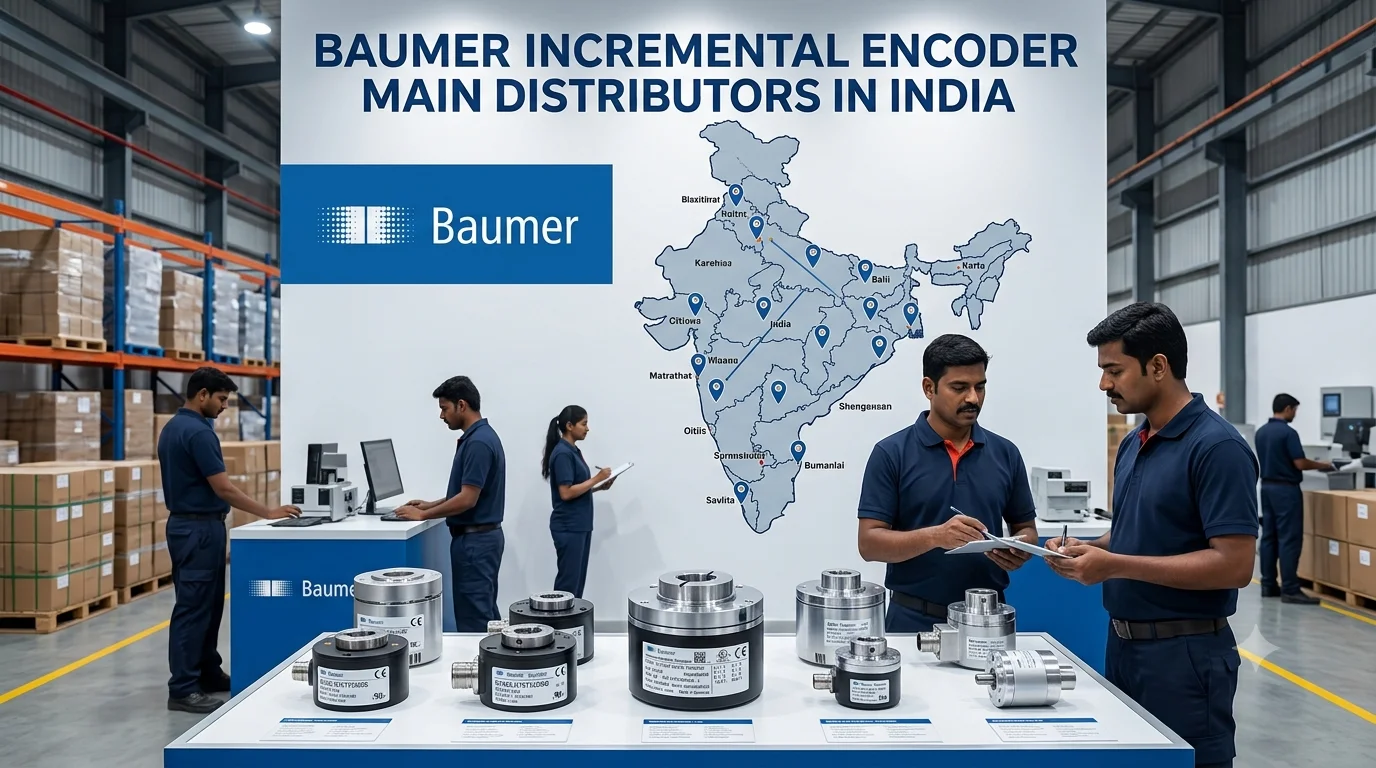
Baumer Incremental Encoder
Baumer Incremental Encoders are rotary measurement devices used to provide speed, direction and relative position feedback to machine-control systems. They generate pulses as the shaft rotates, allowing a PLC, drive or controller to determine how far and how fast a machine component is moving. Baumer offers incremental encoder solutions ranging from compact industrial models to HeavyDuty versions for demanding environments.
Major Applications
1. Motor & Drive Systems
Incremental encoders provide real-time shaft-speed and rotational-position feedback to motors and drives.
Applications:
- AC/DC motors
- Servo and drive systems
- Gear motors
- Pumps and fans
- Speed control
- Motion control
2. Conveyor Systems
Encoders measure conveyor movement and speed, helping synchronize products with automated processes.
Applications:
- Conveyor speed measurement
- Product positioning
- Counting
- Sorting
- Belt monitoring
- Material handling
3. Packaging Machinery
Incremental encoders help synchronize rollers, cutting mechanisms and other rotating machine components.
Applications:
- Filling machines
- Labeling machines
- Printing and packaging
- Cutting systems
- Film handling
- Bottling lines
4. Robotics & Automation
Encoders provide motion feedback for robotic and automated equipment, helping controllers determine shaft movement and position.
Applications:
- Robotic axes
- Pick-and-place machines
- Automated assembly
- Positioning systems
- Handling equipment
5. Steel & Metal Industry
Baumer HeavyDuty incremental encoders are designed for harsh industrial environments such as steelworks and rolling mills.
Applications:
- Rolling mills
- Steel processing
- Large drives
- Generators
- Roller tables
- Continuous production lines
6. Cranes & Lifting Equipment
Incremental encoders can provide speed and angular information for lifting and drive mechanisms.
Applications:
- Port cranes
- Hoists
- Lifting platforms
- Cable drums
- Crane drives
- Material-handling systems
7. Textile Machinery
Encoders help control the speed and movement of rollers and rotating machine components.
Applications:
- Spinning machines
- Winding machines
- Yarn processing
- Textile rollers
- Material feeding
8. Wood, Paper & Plastic Processing
Encoders support accurate speed and movement control in continuous processing machinery.
Applications:
- Wood-processing machines
- Paper production
- Plastic processing
- Cutting equipment
- Rollers
- Linear/motion systems
Baumer also offers incremental linear magnetic encoders for travel measurement and positioning in wood and metal processing, cutting systems, linear drives and other machinery.
Types of Baumer Incremental Encoders
1. Optical Incremental Encoders
These use an optical sensing principle to generate highly precise incremental signals.
Suitable for: automation, motors, machine tools and precision motion applications.
For example, Baumer's G0333 provides A/B/N signals with high pulse-per-revolution options and output frequencies up to 300 kHz.
2. HeavyDuty Incremental Encoders
Designed for demanding environments involving vibration, shock, temperature, dust and other industrial stresses.
Suitable for:
- Steel mills
- Cranes
- Mining
- Large drives
- Wind turbines
- Material handling
Baumer HeavyDuty models are available with solid-shaft and hollow-shaft configurations.
3. SinCos Incremental Encoders
These provide sinusoidal signals and can offer high resolution through interpolation. Baumer's SinCos portfolio includes LowHarmonics technology for high-quality signals.
Benefits:
- High-resolution feedback
- Smooth control
- Improved drive-control quality
- Suitable for demanding motion applications
4. Incremental Encoders with HTL/TTL/RS422 Outputs
Different output interfaces allow integration with various PLCs, drives and control systems. Baumer products are available with configurations including HTL, TTL and RS422/line-driver outputs, depending on the model.
5. Hollow-Shaft Incremental Encoders
These mount directly onto a machine shaft and can simplify mechanical installation.
Baumer's HMG10-B, for example, uses a blind hollow-shaft design and is designed for robust industrial applications.
6. Solid-Shaft Incremental Encoders
These use a projecting shaft connected to the machine through a suitable coupling.
Advantages:
- Flexible mounting
- Suitable for motor and machine applications
- Accurate rotational feedback
- Wide range of mechanical configurations
Key Benefits of Baumer Incremental Encoders
- Accurate speed measurement
- Reliable rotational feedback
- Relative position measurement
- Direction detection
- High-resolution pulse output
- High-speed operation
- Compact and robust designs
- Solid- and hollow-shaft options
- HTL, TTL and RS422 options on suitable models
- HeavyDuty versions for harsh environments
- SinCos options for high-resolution applications
- Suitable for automation and motion-control systems
Baumer models can offer substantial pulse-per-revolution ranges; for example, the G0333 is specified from 6,000 to 80,000 pulses per revolution, depending on configuration.
How Does an Incremental Encoder Work?
Rotating shaft → Sensor detects movement → Pulses generated → PLC/drive counts pulses → Speed & relative position calculated
The A and B channels are phase-shifted, allowing the controller to determine direction of rotation. An additional index/zero pulse can provide a reference point. Baumer documentation describes speed calculation from pulse counts over time and position information from accumulated pulses.
Incremental Encoder vs Absolute Encoder
| Feature | Incremental Encoder | Absolute Encoder |
|---|---|---|
| Main output | Pulses | Position value/code |
| Speed measurement | Excellent | Excellent |
| Relative position | Yes | Yes |
| Position after power loss | Reference may be required | Position retained |
| Typical use | Motors, conveyors, drives | Robotics, positioning, cranes |
| Cost | Often economical | Generally more sophisticated |
| Signal types | A/B, A/B/N, SinCos | SSI, BiSS, fieldbus, Ethernet etc. |
With incremental encoders, a reference movement may be required after power-up because the pulse-based position information does not inherently preserve shaft movement while the system is powered off.
Frequently Asked Questions
Q1. What is a Baumer incremental encoder?
It is a rotary encoder that generates electrical pulses corresponding to shaft rotation for measuring speed, direction and relative position.
Q2. What are the main applications?
Common applications include motors, conveyors, packaging machinery, robotics, machine tools, textile machinery, cranes, steel processing and material handling.
Q3. What is A/B output?
A/B are two phase-shifted incremental signals. Their phase relationship allows the control system to determine the direction of rotation.
Q4. What is the Z or index pulse?
The index pulse provides a reference point during shaft rotation and is commonly used for referencing or zero-position applications.
Q5. What is PPR?
PPR means Pulses Per Revolution. It indicates how many pulses an encoder produces during one complete shaft revolution.
Q6. What is the difference between HTL and TTL?
HTL and TTL are different electrical output signal standards used to transmit encoder signals to controllers and drives. The correct choice depends on the connected control equipment.
Q7. Can Baumer incremental encoders be used in harsh environments?
Yes. Baumer provides HeavyDuty incremental encoder families specifically designed for demanding applications such as steelworks, rolling mills, cranes, mining and wind turbines.
Q8. What is a SinCos encoder?
A SinCos incremental encoder produces sinusoidal signals. These can be interpolated to achieve high-resolution measurement.
Q9. Should I choose a solid-shaft or hollow-shaft encoder?
It depends on the machine's mechanical arrangement. Hollow-shaft versions can mount directly onto suitable drive shafts, while solid-shaft versions generally use a coupling.
Q10. Which Baumer incremental encoder should I choose?
Selection should consider required PPR/resolution, maximum RPM, shaft type, mounting dimensions, output signal, supply voltage, IP rating, temperature, vibration/shock conditions and controller compatibility.
Conclusion
Baumer Incremental Encoders are an important part of industrial motion-control systems, providing dependable feedback for speed, direction and relative position. From precision automation and packaging to steel mills, cranes and heavy-duty machinery, Baumer offers different encoder designs to match both standard and demanding industrial requirements.
- Free shipping: Available
- In stock: Yes


