

Baumer Capacitive Sensor
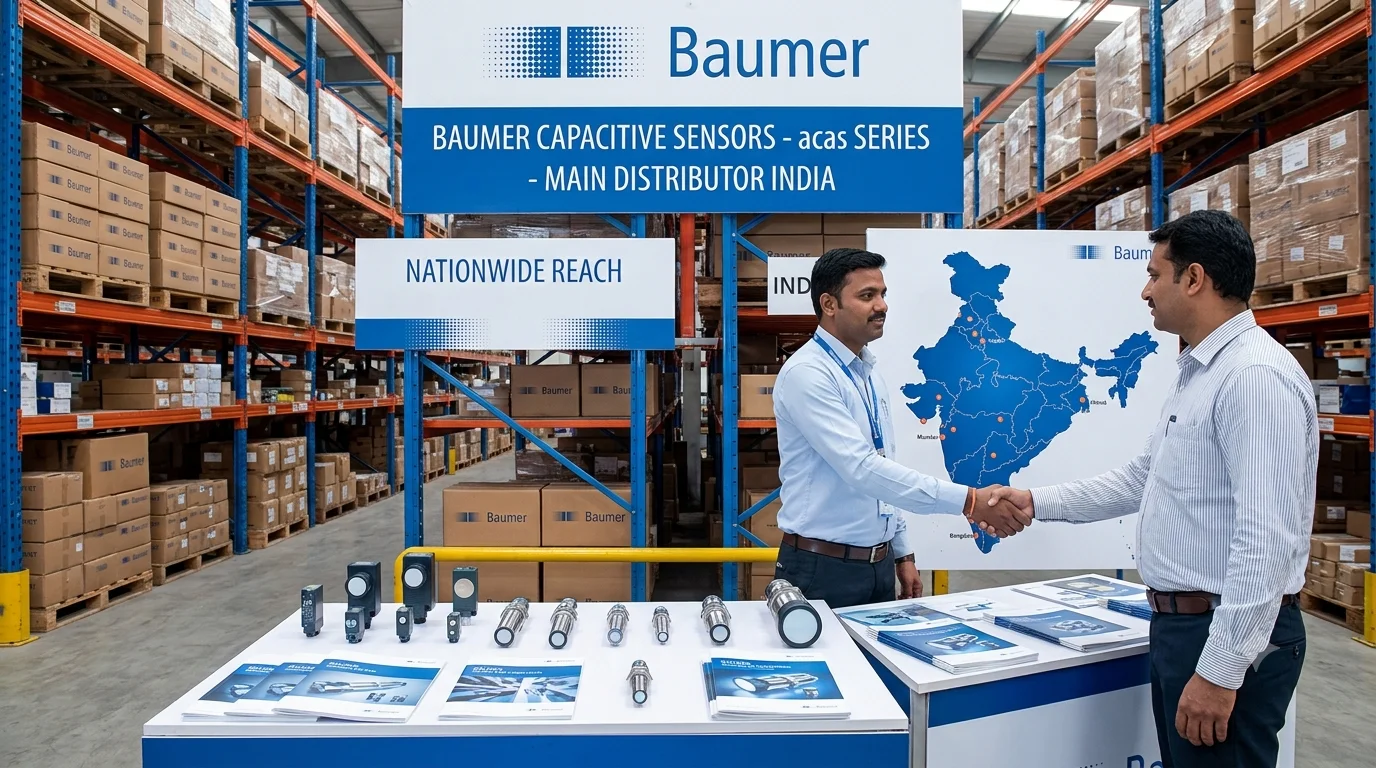
Baumer Capacitive Sensor
Baumer capacitive sensors are non-contact industrial sensors designed to detect both conductive and non-conductive materials, including liquids, plastics, glass, wood, powders and granulates. They work by detecting changes in an electrical field when a target enters the sensor's measuring field.
What Is a Baumer Capacitive Sensor?
A capacitive sensor creates an electrical field around its sensing element. When a material enters this field, its dielectric properties change the capacitance. The sensor electronics evaluate this change and generate a switching signal.
Unlike inductive sensors, which are primarily designed for metal detection, capacitive sensors can detect non-metallic materials as well as conductive materials. This makes them useful for object detection and level monitoring across many industrial applications.
Types of Baumer Capacitive Sensors
1. Capacitive Proximity Sensors
Used for non-contact detection of objects and materials.
Typical targets:
- Plastic
- Glass
- Wood
- Paper
- Granulates
- Liquids
- Metal
Baumer offers cylindrical M12 and M18 designs as well as other compact formats. Depending on the model, switching distances can reach up to 15 mm.
2. Capacitive Level Sensors
Designed for detecting the point level of liquids and solid materials.
They can be installed:
- Directly in contact with the medium
- Outside a tank
- Through plastic or glass container walls
This makes them particularly useful when direct contact with the process material should be avoided.
3. Flush-Mount Capacitive Sensors
These sensors can be mounted flush with the surrounding material. Baumer describes versions with an integrated ground electrode that create a defined measuring field and are particularly suitable for non-conductive materials such as plastics, glass, wood and oils.
4. Non-Flush Capacitive Sensors
Non-flush sensors generally provide a larger sensing field and are particularly suitable for level applications. Baumer notes that conductive media can provide longer sensing distances when properly grounded.
5. Flat / Space-Saving Capacitive Sensors
Baumer offers particularly flat designs for installations where space is limited. Some flat sensors have a housing height of only 6 mm and support flexible mounting.
6. Capacitive Sensors for Through-Wall Detection
These sensors detect material through non-conductive container walls, making them useful for sealed tanks and containers where the sensor should remain outside the process.
Major Applications
1. Liquid Level Detection
Capacitive sensors can monitor the presence or absence of liquids in tanks, bottles and containers.
Examples:
- Water
- Oil
- Ink
- Chemicals
- Milk
- Other process liquids
Baumer capacitive sensors can provide level detection through non-conductive container walls and can also be used with direct media contact.
2. Plastic & Glass Detection
Capacitive sensors can detect objects independently of color and gloss, making them useful for plastic and glass products.
Applications:
- Plastic containers
- Glass bottles
- Plastic boxes
- Packaging components
- Transparent products
Baumer specifically lists presence detection of plastic boxes and detection of objects regardless of transparency or brightness among its applications.
3. Granulate & Bulk Material Detection
Capacitive sensors are useful for detecting granulates, powders and bulk materials in manufacturing equipment.
Applications:
- Injection molding
- Plastic processing
- Material hoppers
- Feed systems
- Storage containers
Baumer cites granulate bulk-goods detection in injection-molding applications.
4. Packaging Machinery
Capacitive sensors can detect products and materials during automated packaging processes.
Applications:
- Bottle detection
- Container presence
- Packaging material detection
- Fill-level monitoring
- Product counting
- Quality checking
Baumer identifies packaging machines as a key application area for its sensor solutions.
5. Printing Industry
Capacitive sensors can be used for ink-level detection and other material-monitoring applications.
Baumer specifically describes ink-level monitoring in offset printing machines, including direct-contact level detection.
6. Laboratory Automation
Capacitive sensors can monitor liquid levels in laboratory equipment and return-flow tanks.
An advantage is that sensors can be mounted outside containers, allowing quick installation without significant process intervention.
7. Food & Beverage
Capacitive sensing can be used for liquid and product detection in automated food and beverage equipment.
Potential applications include:
- Bottle detection
- Liquid monitoring
- Filling systems
- Packaging
- Container-level monitoring
Baumer also provides dedicated sensor solutions for food and beverage automation.
8. Chemical & Aggressive Media
Capacitive level sensors can be used for applications where direct contact with the medium is undesirable. Through-wall detection can help prevent contamination and can be useful with aggressive media.
Key Benefits of Baumer Capacitive Sensors
High Material Flexibility
They can detect conductive and non-conductive materials, including liquids, plastics, glass and bulk materials.
Non-Contact Detection
Non-contact sensing reduces mechanical wear and can allow the sensor to be positioned outside a container.
Through-Wall Detection
Selected Baumer sensors can detect materials through plastic or glass container walls, helping avoid contamination of the process medium.
Color & Surface Independent
Baumer's capacitive sensor portfolio is designed to detect objects independently of color, gloss and surface characteristics.
Resistant to Dust and Dirt
Baumer highlights reliable detection and resistance to dust and soiling for its capacitive sensor solutions.
Compact Designs
M12, M18 and flat sensor designs provide installation flexibility, including applications with limited space.
Easy Installation
Depending on the model, mounting can use threaded connections, cable clamps, adhesive solutions or dedicated mounting frames.
Low Maintenance
Because sensing is contactless and there are no mechanical switching components, capacitive sensors can provide long service life and low maintenance requirements.
Industry 4.0 Connectivity
Selected Baumer level sensors support IO-Link, providing digital configuration and communication capabilities for modern automation systems.
FAQ – Baumer Capacitive Sensors
Q1. What does a Baumer capacitive sensor detect?
It can detect conductive and non-conductive materials, including liquids, plastics, glass, wood, powders and granulates.
Q2. Can a capacitive sensor detect liquid?
Yes. Capacitive sensors are widely used for liquid presence and point-level detection.
Q3. Can Baumer capacitive sensors detect through plastic or glass?
Yes. Selected Baumer models can detect materials through non-conductive container walls.
Q4. Can they detect plastic?
Yes. Plastic is a typical non-conductive material that can be detected by capacitive sensing.
Q5. What is the maximum sensing distance?
It depends on the model. Baumer's capacitive proximity portfolio includes models with switching distances of up to 15 mm, while individual products can have different specifications.
Q6. Are capacitive sensors contactless?
Yes. Baumer capacitive sensors use a non-contact sensing principle, although some level-sensing applications also have variants designed for direct media contact.
Q7. What is the difference between capacitive and inductive sensors?
Inductive sensors are primarily designed for detecting metals, whereas capacitive sensors can detect both conductive and non-conductive materials.
Q8. Are Baumer capacitive sensors suitable for dusty environments?
Selected Baumer capacitive sensors are designed to be relatively insensitive to dust and dirt, although the exact suitability depends on the application and sensor model.
Q9. What factors should be considered when selecting a capacitive sensor?
Consider the target material, dielectric properties, sensing distance, container material and thickness, mounting type, temperature, contamination, electrical output and required interface.
Q10. Where are Baumer capacitive sensors commonly used?
They are used in factory automation, packaging, plastics processing, injection molding, printing, laboratory automation, liquid-level monitoring, food and beverage and process applications.
Conclusion
Baumer Capacitive Sensors provide flexible, non-contact detection for a wide range of industrial materials. Their ability to detect liquids, plastics, glass, granulates and other materials, including through non-conductive container walls, makes them particularly valuable for level monitoring, packaging, material handling, plastics processing and factory automation.
For product selection, the exact sensor should be chosen according to the material, sensing distance, mounting arrangement and operating environment.
- Free shipping: Available
- In stock: Yes


