

Baumer Ultrasonic Sensors
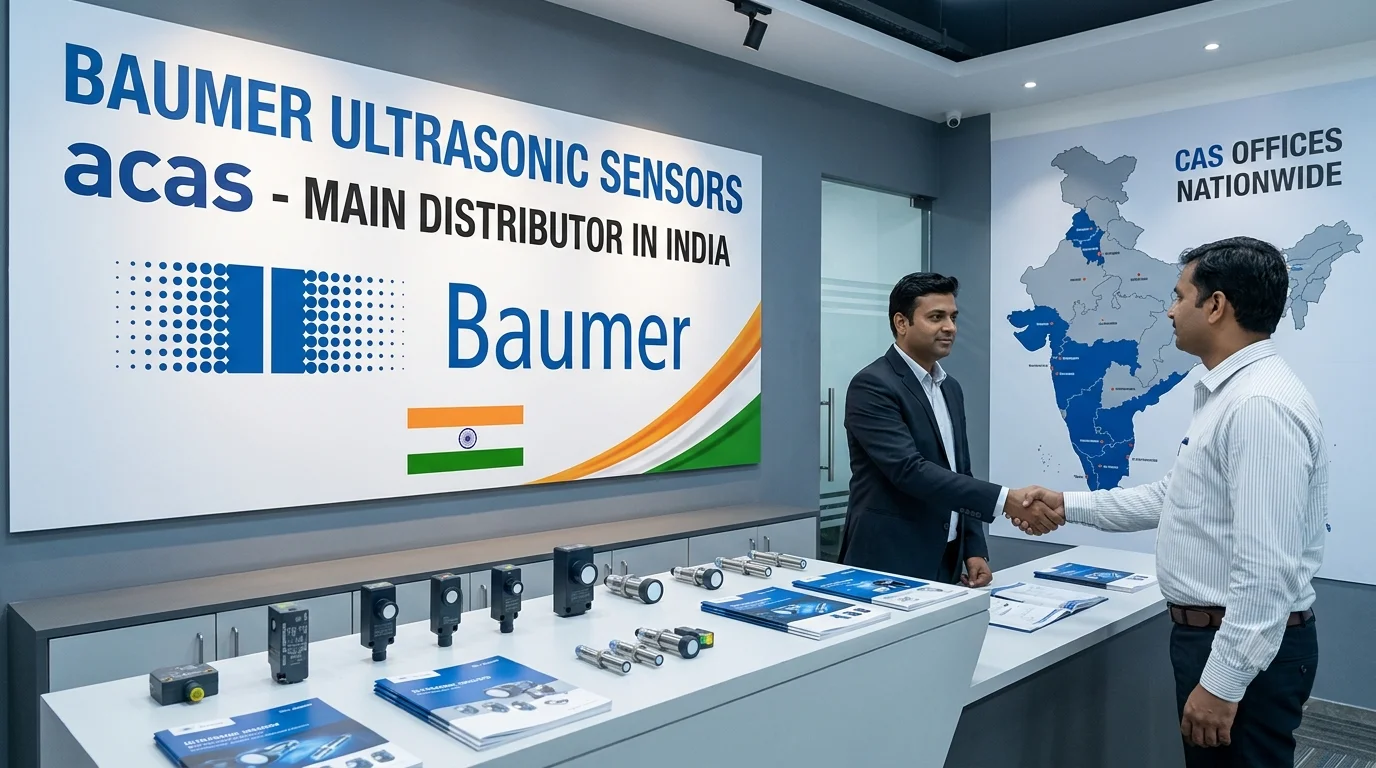
Baumer Ultrasonic Sensors
Baumer Ultrasonic Sensor – Overview, Types, Benefits & Applications
Baumer ultrasonic sensors are industrial sensing devices used for non-contact object detection, distance measurement and level measurement. They work by transmitting high-frequency sound waves and calculating the time taken for the reflected waves to return. This time-of-flight principle allows the sensor to determine the distance to an object.
What is a Baumer Ultrasonic Sensor?
A Baumer ultrasonic sensor is designed to detect objects or measure distances without physical contact. Unlike many optical sensors, ultrasonic sensors can reliably detect transparent, glossy, dark, colored and irregularly shaped objects and can continue working in environments containing dust, moisture or changing ambient light.
Baumer's newer NexSonic technology combines short blind zones, fast response, adjustable sonic cones and smart filtering. Depending on the product family, Baumer offers sensing ranges from very short distances to up to 6,000 mm, while some NexSonic models provide ranges up to 3,000 mm.
How Does It Work?
- The sensor emits ultrasonic sound waves.
- The sound waves travel toward the target.
- The waves reflect from the target surface.
- The sensor receives the reflected signal.
- Electronics calculate the time of flight.
- The sensor provides an object-detection or distance signal.
This allows measurement without touching the target.
Types of Baumer Ultrasonic Sensors
1. Ultrasonic Proximity Sensors
Used primarily for detecting whether an object is present within a defined sensing area. They are suitable for applications such as part presence, stack-height monitoring and object detection.
2. Ultrasonic Distance Sensors
Designed for continuous distance measurement and automation applications. Depending on the model, Baumer offers measuring ranges up to 6 m.
3. Ultrasonic Level Sensors
Used for non-contact measurement of liquids, powders, granules and other materials in containers, tanks and silos.
4. Retro-reflective Ultrasonic Sensors
These use a fixed reflective surface or background and detect changes caused by an object entering the sensing area. They can be useful for irregular, inclined or sound-absorbing targets.
5. Through-beam Ultrasonic Sensors
The transmitter and receiver are separate. They are particularly useful for fast-moving objects, counting, transparent materials and film-break monitoring.
6. Miniature and Compact Sensors
Baumer offers compact designs such as the U300 and UR12 for applications where installation space is limited.
7. Robust Ultrasonic Sensors
The U500 and UR18 families are designed for demanding industrial environments and use a robust sensor element with PEEK protection.
8. IO-Link Ultrasonic Sensors
IO-Link versions provide configuration, diagnostic and additional process-data capabilities, including adjustment of filtering and sonic-cone characteristics.
Key Benefits
- Non-contact measurement
- Reliable detection of transparent and glossy objects
- Works with different colors and surface characteristics
- Less affected by dust, moisture and ambient light
- Suitable for liquids, solids, powders and granules
- Compact sensor designs for restricted installation spaces
- Short blind zones on selected Baumer models
- Fast response for high-speed applications
- Adjustable filtering for difficult environments
- Variable sonic-cone options on selected NexSonic sensors
- IO-Link connectivity on compatible models
- Robust options for demanding industrial conditions
Major Applications
Baumer ultrasonic sensors can be used in:
- Factory automation
- Packaging machinery
- Conveyor systems
- Warehouse and logistics automation
- Bottle and container detection
- Transparent film detection
- Film-break monitoring
- Tank and silo level measurement
- Material and stack-height measurement
- Electronics manufacturing
- Automotive production
- Agricultural and off-highway machinery
- Object counting and positioning
- Quality-control systems
Why Choose Baumer Ultrasonic Sensors?
Baumer provides a broad ultrasonic sensor portfolio covering miniature, high-speed, long-range, robust, chemically resistant, distance-measuring and IO-Link-enabled solutions. Its NexSonic technology is designed to provide fast response, short blind zones, flexible sonic cones and filtering options for challenging automation applications.
Frequently Asked Questions
Q1. What is a Baumer ultrasonic sensor used for?
It is primarily used for non-contact object detection, distance measurement and level measurement in industrial automation.
Q2. Can ultrasonic sensors detect transparent objects?
Yes. Ultrasonic technology can reliably detect many transparent and glossy objects where optical sensing may be less reliable.
Q3. Can Baumer ultrasonic sensors measure liquid levels?
Yes. Baumer offers ultrasonic level sensors for non-contact measurement of liquids and other materials.
Q4. What is the sensing range of Baumer ultrasonic sensors?
The range depends on the model. Baumer's portfolio includes sensors with ranges up to 6,000 mm, while the latest NexSonic UF300 provides up to 3,000 mm.
Q5. Do ultrasonic sensors work in dusty environments?
Yes. Ultrasonic sensing is relatively tolerant of dust, moisture, smoke and similar environmental conditions compared with optical sensing.
Q6. What is IO-Link in a Baumer ultrasonic sensor?
IO-Link allows compatible sensors to be configured and monitored digitally and can provide additional process and diagnostic information.
Q7. What is a blind zone?
The blind zone is the area immediately in front of the sensor where reliable detection or measurement is not possible. Baumer's NexSonic portfolio is designed to achieve particularly short blind zones.
Q8. Are Baumer ultrasonic sensors suitable for fast-moving objects?
Yes. Baumer offers high-speed ultrasonic sensors and NexSonic models with fast response characteristics for applications such as film monitoring, bottle detection and object counting.
Q9. Which Baumer ultrasonic sensor should I choose?
Selection depends on the required sensing distance, target material, installation space, response speed, environmental conditions, output/interface and whether you need object detection, distance or level measurement.
Q10. Where can I find Baumer products and technical information?
Baumer's official product portfolio provides sensor specifications, product families, datasheets and application information.
Baumer Ultrasonic Sensors provide a versatile solution for modern industrial automation, offering reliable non-contact detection and measurement even when targets are transparent, dark, glossy, dusty or difficult for optical sensors. With compact designs, long sensing ranges, fast response, smart filtering and IO-Link options, they can be adapted to a wide variety of manufacturing, packaging, logistics and level-measurement applications.
- Free shipping: Available
- In stock: Yes


