

Baumer Inductive Sensors
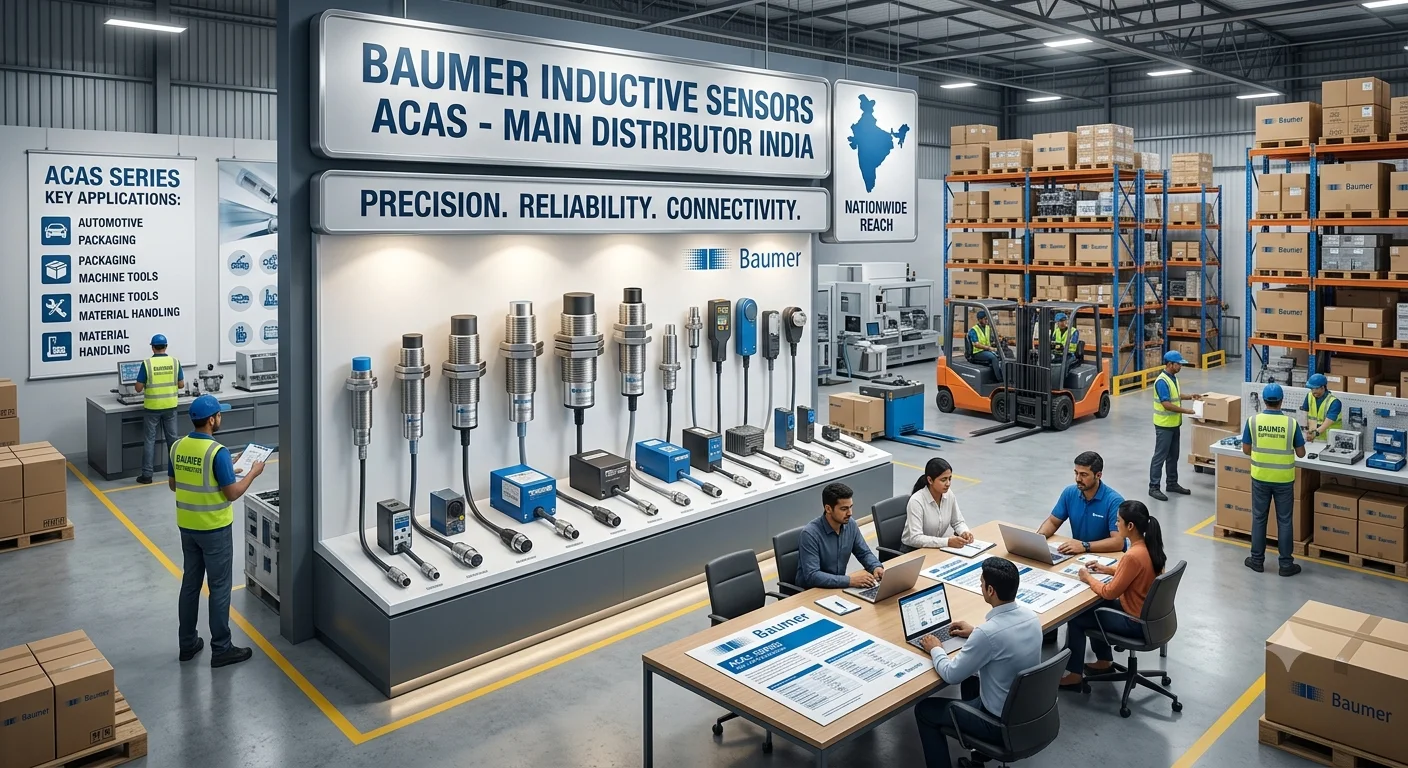
Baumer Inductive Sensors
Baumer inductive sensors are non-contact proximity sensors used to detect metal objects, measure position, monitor movement, and confirm the presence of machine components. They work by generating an electromagnetic field and detecting changes caused by a nearby conductive target.
Main types
| Type | Key feature | Typical use |
|---|---|---|
| Cylindrical sensors | Threaded metal or plastic housing; common sizes include M8, M12, M18, and M30 | General machine automation |
| Rectangular sensors | Compact housing for limited installation space | Conveyor systems and assembly machines |
| Flush-mounted sensors | Sensing face can be installed level with surrounding metal | Industrial equipment and tight mounting locations |
| Non-flush sensors | Longer sensing range but require clearance around the sensing face | Detecting larger targets |
| Factor 1 sensors | Detect different metals at nearly the same sensing distance | Automotive and mixed-metal applications |
| Weld-immune sensors | Resistant to welding sparks and magnetic interference | Robotic welding lines |
| High-temperature sensors | Designed for elevated operating temperatures | Metalworking, furnaces, and foundries |
| Hygienic sensors | Stainless-steel, washdown-resistant construction | Food, beverage, and pharmaceutical equipment |
| Analog inductive sensors | Provide a variable output related to target distance | Position and displacement measurement |
| NAMUR sensors | Low-power two-wire design for hazardous areas with suitable barriers | Process industries and explosive atmospheres |
| IO-Link sensors | Allow digital communication, diagnostics, and parameter setting | Smart factories and predictive maintenance |
| Ring and slot sensors | Detect small metal parts passing through an opening | Counting screws, pins, and wires |
Benefits
- Non-contact operation reduces mechanical wear.
- Reliable detection in dusty, oily, wet, or dirty environments.
- Fast switching for high-speed automation.
- Long service life with minimal maintenance.
- Good resistance to vibration and shock.
- Compact designs for restricted spaces.
- Available with different sensing ranges, outputs, and connection options.
- Easy integration with PLCs, counters, and control systems.
- IO-Link versions provide diagnostics, configuration, and additional process data.
- Specialized models are available for welding, high temperatures, hygiene-critical areas, and hazardous environments.
Common applications
Baumer inductive sensors are commonly used for:
- Detecting the presence or absence of metal parts
- End-position and limit-position monitoring
- Counting metal components
- Conveyor and material-handling systems
- Machine-tool position monitoring
- Robotic arms and welding equipment
- Automotive assembly lines
- Presses, stamping machines, and forming equipment
- Elevator and door-position detection
- Packaging and filling machinery
- Speed and rotation monitoring with suitable target geometries
- Valve and actuator position feedback
- Quality inspection and part classification
- Measuring short-range displacement with analog models
How to select a Baumer inductive sensor
-
Identify the target material.
Standard sensors usually have their rated distance for mild steel. Stainless steel, aluminum, brass, and copper may reduce the effective range unless a Factor 1 model is used. -
Select the sensing distance.
Choose a sensor with enough operating margin. Do not select a model that only detects at the maximum listed range. -
Choose the housing.
Select cylindrical, rectangular, ring, or slot construction according to the available installation space. -
Check flush mounting requirements.
Flush and non-flush sensors have different mounting clearances and sensing characteristics. -
Choose the output.
Common choices include:- PNP or NPN switching output
- Normally open or normally closed
- Push-pull output
- Two-wire NAMUR
- Analog voltage or current
- IO-Link communication
-
Check electrical details.
Confirm supply voltage, current consumption, switching frequency, cable or connector type, and load requirements. -
Check environmental ratings.
Consider IP rating, temperature range, vibration, chemicals, welding sparks, washdown, and hazardous-area requirements. -
Confirm the target speed and size.
Small or fast-moving targets may require a shorter response time and a larger sensing margin.
Frequently asked questions
What does an inductive sensor detect?
It detects conductive materials, especially metals. It does not normally detect plastic, glass, wood, or paper unless those materials contain metal.
How far can an inductive sensor detect?
The range depends on the sensor size and model. Larger sensors generally provide longer ranges. The actual range also depends on the target’s material, size, shape, and orientation.
What is the difference between flush and non-flush mounting?
A flush sensor can be mounted level with surrounding metal. A non-flush sensor generally offers a longer sensing distance but needs additional clearance around its sensing face.
What is a Factor 1 sensor?
A Factor 1 sensor is designed to detect common metals—such as steel, stainless steel, aluminum, brass, and copper—with similar sensing distances.
Can an inductive sensor detect aluminum?
Yes. However, a standard sensor may detect aluminum at a shorter distance than steel. A Factor 1 model is preferable when consistent detection of multiple metals is required.
What do PNP and NPN mean?
PNP sensors source positive voltage to the output when activated. NPN sensors switch the output toward 0 V. The choice must match the PLC or controller input.
What is IO-Link used for?
IO-Link enables sensor parameter setting, diagnostics, device identification, process values, and maintenance information through a compatible IO-Link master.
Are Baumer inductive sensors waterproof?
Many models have high IP protection, such as IP67 or higher, but the exact rating depends on the product. The sensor’s datasheet should be checked for continuous immersion, washdown, and chemical exposure.
Can inductive sensors be used in welding areas?
Yes. Weld-immune versions are designed to resist welding spatter and electromagnetic interference. Standard sensors may fail prematurely in these conditions.
How should the sensor be installed?
Keep the sensing face aligned with the target, maintain the manufacturer’s mounting clearance, avoid excessive mechanical impact, and route sensor cables away from strong sources of electrical interference.
Why does the sensor detect intermittently?
Common causes include insufficient sensing margin, target misalignment, excessive speed, metal chips on the sensing face, vibration, incorrect wiring, or unsuitable mounting clearance.
How can sensor life be improved?
Use the correct environmental version, protect the cable and connector, avoid mechanical contact with the sensing face, provide adequate sensing distance, and use surge protection where required.
Summary
Baumer inductive sensors provide dependable, non-contact metal detection for industrial automation. Standard cylindrical and rectangular models suit general applications, while Factor 1, weld-immune, hygienic, high-temperature, analog, NAMUR, and IO-Link versions address specialized requirements. The most important selection factors are target material, sensing distance, mounting style, output type, environmental conditions, and PLC compatibility.
Industrial Automation component supplier and Automation solution provider
- Free shipping: Available
- In stock: Yes


